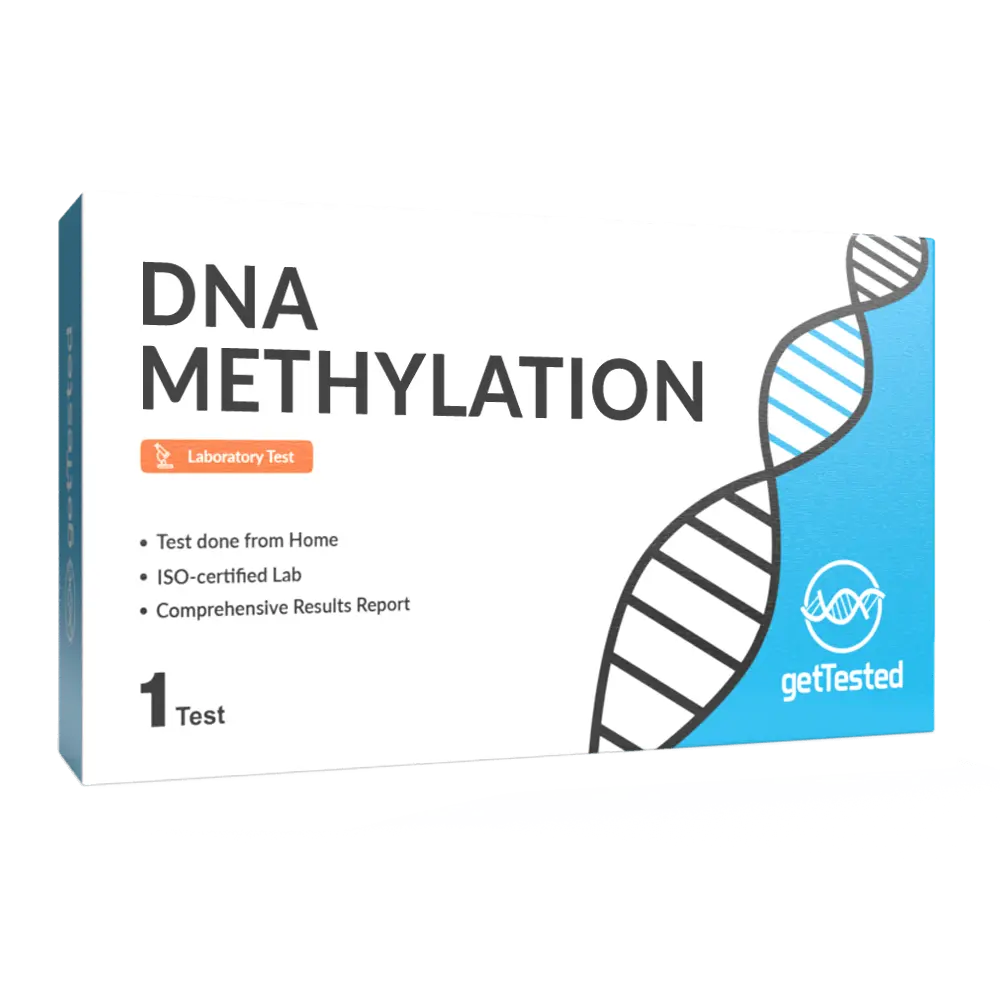
DNA Methylation Test
Analyse epigenetic methylation for insight into ageing, disease risk and genetic health. Simple home DNA test.
Product details: GBP 199 — InStock — SKU DNAM — GetTested
About this test
Key Benefits
Gain insight into how genetic variation may influence methylation and folate pathways
Simple At-Home Testing: Collect your sample easily using a saliva test
Focused Methylation Insights: Covers folate metabolism, homocysteine balance, and methyl donor activity
Personalized Insights: Understand how your body may respond to methylation-related factors
Supports Informed Decisions: Helps guide nutrition, supplementation, and lifestyle choices
What This Test Measures
This test analyzes 21 genetic markers involved in core methylation pathways related to folate use, homocysteine balance, and methyl donor activity.
Folate and vitamin B pathways
These genes are involved in how the body uses folate and vitamin B12, nutrients that support DNA production, cell renewal, and nervous system function. Variations in these pathways may provide context for energy, mood, cognitive function, and cellular health.
Genes included:
DHFR, FOLH1, MTHFD1, MTHFR, MTHFS, MTR, MTRR, SHMT1, SLC19A1, TCN1
Methylation and homocysteine balance
These genes are linked to how the body manages homocysteine and methyl donors. This balance connects nutrient status, cardiovascular health, detoxification pathways, and normal brain function.
Genes included:
BHMT, BHMT2, CHDH, COMT, GNMT, MAT1A, PEMT
Supporting detoxification and cellular pathways
These genes support processes related to sulfur compounds, oxidative stress, and cellular protection, helping maintain biochemical balance.
Genes included:
CBS, CPS1, ENOSF1, PRXL2A
About Methylation and Health
Methylation is a biochemical process involved in gene regulation, neurotransmitter balance, DNA synthesis, and homocysteine metabolism. It plays an important role in how the body maintains normal biological function.
These pathways are closely connected to how the body utilizes nutrients such as folate, vitamin B12, vitamin B6, choline, and other methyl donors, which are essential for healthy methylation activity.
Genetic variation in methylation-related genes may influence how efficiently these pathways function, which may affect processes related to energy, mood, cognitive function, and overall well-being. Understanding these pathways may support a more personalized approach to health and lifestyle choices.
How It Works
Order Your Kit
Purchase your test onlineCollect Your Sample
Provide a saliva sample at home using the collection kitSend It Back
Mail your sample to the laboratory using the prepaid return envelopeReceive Your Results
Access your detailed digital results within 3–5 weeks
About the Result Reports
Once your analysis is complete, you will receive three separate DNA reports based on your selected tests. These are typically delivered at the same time.
Each report is designed to be clear and easy to understand, including your genetic results along with explanations and personalized insights.
You will also have access to an example report, allowing you to preview the structure and content in advance.
If you need help interpreting your results, our support team is available to assist you.
Please note: Reports are available in English only.
Sample Collection
The sample is collected using a simple saliva test at home. You provide a small saliva sample in the collection tube, which is then sent to the laboratory for analysis.
This method is non-invasive, convenient, and easy to perform, making it suitable for home testing.
ISO-Certified Lab and Analysis
Your sample is analyzed in an ISO-certified laboratory using the Illumina GSA Microarray, a type of SNP genotyping.
This technology enables accurate and reliable analysis of genetic markers associated with methylation pathways, folate metabolism, and homocysteine balance.
Biomarkers included
- PRXL2A: PRXL2A (Peroxiredoxin-like 2A): PRXL2A is a gene that encodes a protein involved in reducing peroxide levels within cells, helping protect them from oxidative stress. This enzyme plays a role in cell survival, proliferation, and response to stress. Research on PRXL2A continues to explore its contributions to aging, cancer, and diseases linked to oxidative damage.
- BHMT: BHMT (Betaine-Homocysteine S-Methyltransferase): BHMT is an enzyme that reflects the body’s ability to metabolize homocysteine, a process important for cardiovascular and neurological health. BHMT catalyzes the conversion of homocysteine to methionine using betaine as a methyl donor. Dysregulation of BHMT can lead to elevated homocysteine levels, which are associated with cardiovascular disease an
- MTR: MTR (5-Methyltetrahydrofolate-Homocysteine Methyltransferase): MTR is a critical enzyme involved in the remethylation pathway of homocysteine metabolism. It catalyzes the transfer of a methyl group from 5-methyltetrahydrofolate (5-MTHF) to homocysteine, producing methionine and tetrahydrofolate (THF). Methionine is a precursor for S-adenosylmethionine (SAM), a universal methyl donor essential for
- GNMT: GNMT (Glycine N-Methyltransferase) is an important enzyme involved in methionine metabolism and liver detoxification. It helps regulate homocysteine levels by converting excess methionine into sarcosine, preventing harmful methionine accumulation and supporting liver health. Dysfunction of GNMT is associated with liver conditions such as fatty liver disease and liver cancer. Ongoing research highl
- ENOSF1: ENOSF1 (Enolase Superfamily Member 1): ENOSF1 is a protein involved in the cellular response to vitamin B2 (riboflavin) availability. It plays a role in the metabolism of cancer cells, especially in how they adapt to changes in nutrient conditions. Changes in ENOSF1 expression have been studied in relation to tumor metabolism, indicating a possible role in cancer progression and the development of
- PEMT: PEMT (Phosphatidylethanolamine N-Methyltransferase): PEMT is an enzyme that converts phosphatidylethanolamine to phosphatidylcholine in the liver, a key step for maintaining cell membrane structure and enabling VLDL secretion. Its activity affects liver function, fat metabolism, and choline needs, with dysregulation linked to liver and cardiovascular disease risk.
- DHFR: DHFR (Dihydrofolate Reductase) is an enzyme that plays a key role in DNA synthesis and repair. It catalyzes the conversion of dihydrofolate to tetrahydrofolate, a necessary cofactor for producing purines, thymidylate, and certain amino acids. This process is essential for cell growth and division, making DHFR a critical target in cancer treatment, where inhibitors like methotrexate block its activ
- BHMT2: BHMT2 (Betaine-Homocysteine S-Methyltransferase 2) is a gene involved in homocysteine metabolism, working similarly to its counterpart, BHMT. It helps convert homocysteine to methionine, a process important for cardiovascular and neurological health. Although less studied than BHMT, BHMT2 influences homocysteine levels in the body, which may affect heart function and neurological conditions. Under
- FOLH1: FOLH1 (Folate Hydrolase 1), also known as Prostate-Specific Membrane Antigen (PSMA), is a gene involved in folate metabolism and the activation of folate for DNA synthesis and repair. It plays a key role in cell growth and division. FOLH1 is notably expressed in prostate cancer cells, making it a valuable target for cancer diagnosis and therapy.
- CHDH: CHDH (Choline Dehydrogenase) is an important enzyme involved in choline metabolism, converting choline into betaine. This conversion supports the production of acetylcholine, a key neurotransmitter, and helps regulate homocysteine levels, which is important for cardiovascular health. CHDH activity influences choline availability, affecting liver function, brain development, and nervous system heal
- MTHFS: The MTHFS gene encodes methenyltetrahydrofolate synthetase, an enzyme involved in folate metabolism. It plays a crucial role in maintaining the pool of active folate derivatives used for methylation, DNA synthesis, and neurotransmitter production. MTHFS regulates the conversion of various folate forms and helps maintain the balance of one-carbon units essential for cellular function. Variants in t
- MTHFR: MTHFR (Methylenetetrahydrofolate Reductase): MTHFR is an enzyme that plays a central role in folate metabolism and the regulation of homocysteine levels. It converts 5,10-methylenetetrahydrofolate into 5-methyltetrahydrofolate, enabling the remethylation of homocysteine to methionine — a precursor to S-adenosylmethionine (SAM), the body’s primary methyl donor. Variants in the MTHFR gene, such as C
- TCN1: TCN1 encodes the protein haptocorrin, also known as transcobalamin I, which binds vitamin B12 (cobalamin) in the saliva and protects it from degradation in the acidic environment of the stomach. This initial binding allows B12 to reach the small intestine, where it is then transferred to intrinsic factor for absorption. Variants in the TCN1 gene may affect the stability or availability of B12 in t
- MAT1A: MAT1A (Methionine Adenosyltransferase I, Alpha) is an enzyme that produces S-adenosylmethionine (SAMe), the body’s primary methyl donor for key metabolic processes. It plays a central role in methionine metabolism, influencing gene regulation, cell growth, and detoxification. Reduced MAT1A activity is linked to liver disorders such as cirrhosis and hepatocellular carcinoma.
- COMT: COMT (Catechol-O-Methyltransferase): COMT is an enzyme that plays a key role in the metabolism of catecholamines, including dopamine, epinephrine, and norepinephrine. It is important for regulating neurotransmitter levels in the brain and is linked to psychiatric disorders such as schizophrenia. COMT also contributes to the body’s pain response and has been studied in relation to pain sensitivity
- SHMT1: SHMT1 (Serine Hydroxymethyltransferase 1): SHMT1 is an enzyme that catalyzes the conversion of serine and tetrahydrofolate into glycine and methylenetetrahydrofolate. This process is essential for nucleotide synthesis and methylation reactions, which support DNA replication and repair. SHMT1 plays a key role in cell growth and genetic stability, and its activity in folate metabolism is linked to c
- SLC19A1: The SLC19A1 gene encodes the reduced folate carrier 1 (RFC1), a key transporter responsible for moving folate and folate derivatives into cells. This transport system is vital for cellular uptake of folate, which is necessary for DNA synthesis, repair, methylation processes, and red blood cell formation. Variants in this gene may impair folate transport, potentially leading to reduced intracellula
- MTRR: MTRR (Methionine Synthase Reductase): MTRR is an enzyme that plays a critical role in regenerating methylcobalamin, supporting the continuous function of MTR in homocysteine metabolism. It is essential for maintaining proper methionine levels and normal DNA synthesis. Mutations in MTRR are linked to homocystinuria, which can contribute to developmental and neurological complications. Understanding
- CBS: CBS (Cystathionine beta-synthase): CBS is an enzyme essential for sulfur metabolism, playing a key role in converting homocysteine to cysteine. This process supports the production of glutathione, an important antioxidant for protecting cells against oxidative stress. CBS also participates in the transsulfuration pathway, which regulates sulfur-containing amino acids and hydrogen sulfide, a signal
- CPS1: CPS1 (Carbamoyl-phosphate synthase 1): CPS1 is a key enzyme in the urea cycle that plays a vital role in detoxifying ammonia in the body. It catalyzes the formation of carbamoyl phosphate from ammonia and bicarbonate, starting the process of urea synthesis in the liver. The urea cycle is essential for removing excess nitrogen produced from protein and amino acid breakdown, preventing toxic ammonia
- MTHFD1: MTHFD1 (Methylenetetrahydrofolate Dehydrogenase 1): MTHFD1 is a key enzyme in the folate metabolism pathway, catalyzing the conversion of tetrahydrofolate (THF) derivatives into forms used for the synthesis of DNA, RNA, and amino acids. It plays a vital role in one-carbon metabolism, influencing cellular methylation reactions and nucleotide production. Mutations or dysregulation of MTHFD1 can disr
How to prepare
No special preparation is required before taking the test. Avoid eating, drinking, smoking, or chewing gum for at least 30 minutes before sample collection to ensure sample quality.
Frequently asked questions
What is methylation?
Methylation is a biological process involved in gene regulation, neurotransmitter balance, DNA synthesis, and homocysteine metabolism. It plays an important role in many normal cellular functions.
What nutrients are connected to methylation?
Methylation pathways rely on nutrients such as folate, vitamin B12, vitamin B6, choline, and methyl donors, which help support normal biochemical processes.
What is the difference between DNA Methylation Test and DNA Methylation Plus?
DNA Methylation Test focuses on core methylation pathways related to folate metabolism, homocysteine balance, and methyl donor activity. DNA Methylation Plus includes a broader range of genes connected to methylation, detoxification, vitamin transport, and cellular health, providing a more comprehensive analysis of methylation-related pathways.
Can I receive the raw data from my test?
No. We provide your results in a comprehensive report with the relevant values and interpretations. We do not provide the raw laboratory data.
Customer reviews
4.7/5 (3)
- 5/5 — Great test for understanding my B vitamin needs.
- 5/5 — Easy to use and the saliva kit was straightforward.
- 4/5 — The insights into my folate metabolism were very helpful for my diet. The report took about 7 weeks to arrive but it was worth the wait.