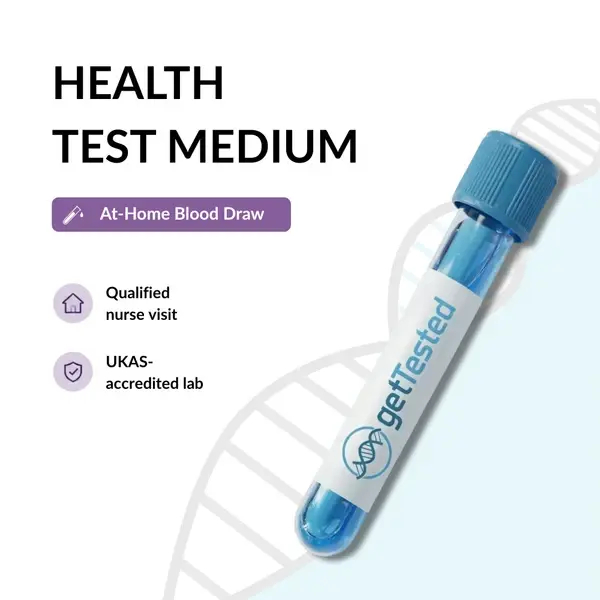
Health Test Medium
A focused health check from home — 27 markers covering cholesterol, blood sugar, iron, liver, kidney & vitamins. Home visit; UKAS lab, results in 1–3 days.
Product details: GBP 182 — OutOfStock — SKU IN461 — GetTested
About this test – Health Test Medium
Key Benefits
27 Biomarkers and Calculated Health Values: Covers cholesterol, blood sugar, iron status, liver, kidney, protein balance and key vitamin markers.
At Home Blood Collection: Your blood sample is collected in the comfort of your home and taken for laboratory analysis.
Appointment Arranged Within 48 Hours: A healthcare professional will contact you within 48 hours to arrange your appointment.
UKAS Accredited Laboratory: Your sample is analysed by a UKAS accredited laboratory.
Fast Online Results: Secure online results are available within 1 to 3 working days.
What This Test Measures
Heart and Lipid Health
Looks at cholesterol and lipid patterns commonly used to understand cardiovascular and metabolic health.
Blood Sugar and Metabolic Health
Provides insight into longer term blood sugar regulation and uric acid, adding context around metabolism and overall health.
Iron Status
Helps assess iron availability, transport and storage, which may be relevant for tiredness, low energy and poor recovery.
Kidney Function
Helps assess kidney filtration and waste removal.
Liver Function and Protein Balance
Provides insight into liver enzyme patterns, bilirubin and blood proteins linked to liver function, nutrition and general balance.
Vitamin Status
Includes key vitamins linked to energy, immune function, blood health, nervous system function and overall wellbeing.
How It Works
1. Order Your Test
Purchase your test online.
2. Arrange Your Appointment
A healthcare professional will contact you within 48 hours to arrange your at home blood collection appointment.
3. Blood Sample Collection
Your blood sample is collected in the comfort of your home.
4. Laboratory Analysis
Your sample is analysed by a UKAS accredited laboratory.
5. Receive Your Results
Access your secure online results within 1 to 3 working days.
Laboratory Quality and Accreditation
Your sample is analysed by a UKAS accredited laboratory operating in accordance with ISO 15189 standards, the internationally recognised standard for medical laboratories.
The laboratory follows established procedures for sample handling, analysis and quality control to support accurate and reliable results. Your results are securely returned to GetTested and made available through your online account.
Preparation Instructions
Fasting: Fasting is not usually required for this test.
Before Testing: Stay well hydrated before your appointment and avoid heavy alcohol intake or unusually intense exercise the day before your blood sample is collected.
Medication: Do not stop or change any prescribed medication unless advised by a healthcare professional.
Important
This test is not a substitute for urgent medical care. If you require immediate medical attention, contact your healthcare provider or emergency services.
Biomarkers included – Health Test Medium
- HDL % of total: Heart and Lipid Health — The HDL percentage of total cholesterol is a ratio that compares 'good' HDL cholesterol to your overall cholesterol count. It is a critical marker for assessing cardiovascular risk, as it indicates how much of your total cholesterol is actively being cleared from the bloodstream rather than accumulating in the arteries.
- HDL Cholesterol: Heart and Lipid Health — HDL cholesterol, often referred to as "good" cholesterol, is a type of lipoprotein that carries cholesterol from other parts of your body back to your liver, where it is broken down and removed from the body. Higher levels of HDL are generally associated with a lower risk of heart disease and stroke, as it helps prevent the buildup of cholesterol in the arteries. Measuring HDL levels is important
- Non-HDL Cholesterol: Heart and Lipid Health — Non HDL cholesterol represents the total amount of cholesterol carried by all cholesterol containing particles except HDL. This includes LDL cholesterol and other particles that may contribute to cholesterol buildup in blood vessels. Because it includes more cholesterol carrying particles than LDL alone, non HDL cholesterol can provide a broader view of lipid related cardiovascular risk. It may be
- LDL Cholesterol: Heart and Lipid Health — LDL cholesterol, often referred to as "bad" cholesterol, is a type of lipoprotein that carries cholesterol to your tissues and arteries. High levels of LDL can lead to the buildup of cholesterol in the arteries (atherosclerosis), increasing the risk of heart disease, heart attack, and stroke. Measuring LDL levels is a key component of assessing cardiovascular health and determining the need for li
- Triglycerides: Heart and Lipid Health — Triglycerides are a type of fat (lipid) found in your blood. Your body uses triglycerides for energy, but high levels can increase your risk of heart disease and other health problems. They are primarily measured to assess cardiovascular health and metabolic risk.
- Total Cholesterol: Heart and Lipid Health — Total cholesterol is a measure of the total amount of cholesterol in your blood, including LDL (bad), HDL (good), and other lipid components. While it provides a general overview of cholesterol levels, it's important to consider the individual levels of LDL and HDL for a more complete assessment of cardiovascular risk. High total cholesterol can increase the risk of heart disease and stroke.
- Uric Acid: Blood Sugar and Metabolic Health — Uric acid is a waste product formed from the breakdown of purines, substances found in certain foods and drinks (like red meat, seafood, and alcohol). It is normally excreted by the kidneys. High uric acid levels (hyperuricemia) can lead to the formation of uric acid crystals in joints, causing gout, a painful form of arthritis. It can also increase the risk of kidney stones. Measuring uric acid l
- HbA1c (Hemoglobin A1c): Blood Sugar and Metabolic Health — HbA1c (Hemoglobin A1c) measures the average blood glucose levels over the past 2-3 months by assessing the percentage of hemoglobin in red blood cells that is coated with sugar. It's a crucial indicator for diagnosing and monitoring diabetes, as persistently high levels denote poor long-term glucose control, increasing the risk of diabetes-related complications. This test provides a more stable an
- Transferrin Saturation: Iron Status — Transferrin saturation is a measure that reflects the percentage of transferrin — a blood protein that transports iron — that is actually bound to iron. It helps assess how effectively iron is being carried and utilized in the body. This marker is useful for identifying iron deficiency or iron overload, and is typically calculated using serum iron and total iron-binding capacity (TIBC). Low levels
- Total Iron Binding Capacity (TIBC): Iron Status — Total Iron Binding Capacity (TIBC) is a blood test that reflects the blood's capacity to bind and transport iron through transferrin — the main iron-carrying protein. It provides an indirect measure of available transferrin and is commonly used alongside other iron tests to help assess iron deficiency, anemia, or iron overload conditions.
- Iron: Iron Status — Iron is an essential mineral critical for oxygen transport, energy production, and cellular function throughout the body. It is a key component of hemoglobin in red blood cells and myoglobin in muscles, enabling oxygen delivery to tissues. Iron also plays vital roles in DNA synthesis, immune function, and cognitive development. Measuring iron levels helps diagnose anemia, assess nutritional status
- Unsaturated Iron Binding Capacity (UIBC): Iron Status — Unsaturated Iron Binding Capacity (UIBC) measures the amount of transferrin that is not saturated with iron, indicating the total amount of iron that could potentially be bound and transported in the blood. A high UIBC suggests the body needs more iron or is unable to properly utilize it, often seen in iron deficiency anemia.
- Ferritin: Iron Status — Ferritin is a protein that stores iron inside cells and serves as a key indicator of the body’s iron reserves. Measuring ferritin helps assess iron status: low ferritin is commonly associated with depleted iron stores and iron deficiency. Elevated ferritin can occur with iron overload, but it may also rise in response to inflammation, infection, liver disease, or other chronic conditions because f
- eGFR: Kidney Function — Estimated Glomerular Filtration Rate (eGFR) is a calculation used to estimate how well the kidneys filter waste products from the blood. It is considered the gold standard for assessing kidney function and is essential for detecting, staging, and monitoring chronic kidney disease.
- Creatinine: Kidney Function — Creatinine is a waste product formed in muscles from the normal breakdown of creatine. It is released into the bloodstream and filtered by the kidneys, then excreted in urine. Because creatinine levels are influenced by how efficiently the kidneys filter blood, it is commonly used to assess kidney function. Elevated creatinine may indicate reduced kidney filtration or kidney disease, while low lev
- Urea: Kidney Function — Urea is a waste product formed in the liver through the breakdown of proteins. After formation, it is transported to the kidneys and eventually excreted in the urine. Measuring urea levels in the blood, often called blood urea nitrogen (BUN), is a common test used to evaluate kidney function. Elevated blood urea levels can indicate impaired kidney function or other issues affecting waste processin
- ALP (Alkaline phosphatase): Liver Function — Alkaline phosphatase (ALP) is an enzyme present in several tissues throughout the body, especially in the liver, bones, kidneys, and digestive system. ALP plays an important role in breaking down proteins and in dephosphorylation processes. In the liver, it’s associated with bile ducts and is commonly used to help diagnose liver and bone conditions. Elevated ALP levels may indicate bile duct obstr
- Globulin: Liver Function — Globulin is a group of blood proteins that play important roles in the body, including transporting hormones, lipids, vitamins, and minerals. They are also key components of the immune system, with some globulins functioning as antibodies that help defend against infections. Produced by the liver and immune system, globulin levels can provide insight into immune health, liver function, and nutriti
- Bilirubin: Liver Function — Bilirubin is a yellow pigment formed when red blood cells are broken down. It is transported to the liver, where it is processed (conjugated) and then excreted through bile. Measuring bilirubin helps assess how well the liver and bile flow pathways are functioning. Elevated levels may be seen with liver or bile duct problems (such as impaired bile flow) or with increased breakdown of red blood cel
- Alanine Aminotransferase (ALT): Liver Function — Alanine aminotransferase (ALT) is an enzyme found mainly in liver cells. When liver cells are stressed or damaged, ALT can leak into the bloodstream, which is why it’s commonly used as a marker of liver health. Elevated ALT levels may indicate liver inflammation or injury and are seen in a range of conditions affecting the liver. ALT is typically interpreted together with other liver-related marke
- Total Protein: Liver Function — Total protein is a measure that reflects the combined levels of two major blood proteins — albumin and globulin. Albumin, the most abundant protein in blood plasma, helps maintain oncotic pressure and transports various substances, while globulins play key roles in immune response, blood clotting, and other functions. Total protein levels provide important insights into nutritional status as well
- Albumin: Liver Function — Albumin is the most abundant protein in blood plasma and is produced by the liver. It helps maintain oncotic (osmotic) pressure, keeping fluid within the bloodstream, and it also transports many substances such as hormones, fatty acids, and certain medications. Measuring albumin can provide useful information about liver synthetic function and overall protein status. Abnormal levels may be seen in
- Aspartate Aminotransferase (AST): Liver Function — Aspartate aminotransferase (AST) is an enzyme found in several tissues, including the liver, heart, skeletal muscle, kidneys, and red blood cells. It is involved in amino acid metabolism and can be released into the bloodstream when cells in these tissues are stressed or damaged. Elevated AST may indicate liver injury, but because AST is not liver-specific, increased levels can also be seen with m
- Gamma GT: Liver Function — Gamma-glutamyl transferase (GGT) is an enzyme found primarily in the liver that helps transport molecules across cell membranes and plays a role in glutathione metabolism. It is a highly sensitive marker used to detect liver or bile duct injury and can help distinguish between bone and liver disease when other enzymes are elevated.
- Folate: Vitamin Status — Folate (vitamin B9) is a water-soluble vitamin essential for DNA synthesis, cell division, and normal red blood cell formation. It is especially important during pregnancy because adequate folate status supports early fetal development and helps reduce the risk of neural tube defects. Folate also participates in methylation pathways and homocysteine metabolism, where low folate can contribute to e
- Vitamin D: Vitamin Status — Vitamin D is a fat-soluble vitamin crucial for calcium absorption and bone health, playing a key role in phosphorus metabolism and immune system function. Its importance extends to muscle function, nerve signaling, and reducing inflammation. Maintaining adequate vitamin D levels is vital for overall well-being and disease prevention.
- Active B12: Vitamin Status — Active B12, also known as holotranscobalamin, is the specific portion of Vitamin B12 that is actually available for your cells to use. Unlike a standard total B12 test, measuring Active B12 provides a more accurate reflection of your functional vitamin status and can detect a deficiency at an earlier stage.
Frequently asked questions – Health Test Medium
Why is a full blood count included in this test?
A full blood count provides insight into red blood cells, white blood cells and platelets, which can add useful context around tiredness, infection patterns, inflammation, general health and recovery.
Can this test help if I feel tired or low in energy?
Yes. This test includes markers such as full blood count, ferritin, HbA1c, liver and kidney markers, which may provide useful context when exploring tiredness, low energy or general wellbeing.
Can I reschedule my appointment?
Yes, appointments can be rearranged. Please provide sufficient notice before your scheduled appointment.
What happens if my sample cannot be analysed?
If a sample is unsuitable for analysis, our customer support team will contact you with information about the next steps.
Customer reviews – Health Test Medium
4.7/5 (3)
- 4/5 — Good overview of my general health markers. The digital report was easy to read, though I wish it came with more dietary advice.
- 5/5 — Fast results!
- 5/5 — Quick way to check my iron and cholesterol levels from home. Very convenient.